Can I go camping for Bonfire Night in November UK: yes, if the site is open and your bag is rated for it
Bonfire Night camping is possible in most of the UK, but it is a different trip from a warm October weekend. The campsite has to be open, the sleeping bag has to be rated for the night you will actually get, and you need to be pitched before the sun goes down at half past four.
We earn commission from qualifying Amazon purchases. It costs you nothing and does not affect what we recommend.
Quick answer
Can I go camping for Bonfire Night in November UK? Yes, if three things line up: a campsite that is open and taking tents that weekend, a sleeping bag whose comfort rating is below the forecast overnight low, and arrival early enough to pitch before sunset at about 16:20 to 16:30. If any of those fails, book a heated pod instead or wait for spring.
Bonfire Night falls on Thursday 5 November 2026, so the displays, and the camping, cluster on the weekend either side. The real question is whether a tent is still a sensible place to sleep once the clocks have gone back and the first frosts are in the forecast. Five things decide that, and none of them is the calendar.
The five checks that settle it
The first check rules out most sites, the fourth rules out most sleeping bags, and the rest decide whether the weekend is pleasant or a slog.
1. Is the campsite open, and is it taking tents?
A large share of UK campsites close on the last Sunday in October or the first weekend in November, and many that stay open switch to hardstanding for vans only. Open all year is not the same as taking tents in November. Check the booking page, then phone and ask: are tents accepted that weekend, what is the arrival cut-off, and is the shower block heated.
A smaller group of sites lean into the date, sitting within walking distance of a town display or running a bonfire on the field themselves. Book direct and confirm the display date with the site rather than trusting last year's magazine list.
2. What is the forecast overnight low, and the wind?
Pull up a forecast for the site itself, not the nearest city. A valley campsite can sit three or four degrees colder than the town up the road on a clear night. The two numbers that matter are the overnight minimum for Friday and Saturday and the gust speed. Gusts above about 35 mph make it a night to reconsider in a tent; our guide on when to cancel a camping trip for a storm goes through where that line falls.
A clear, still night is the classic frost setup and also the best night for fireworks, so you are often trading a good view of the display for a colder tent.
3. What state is the ground in?
Autumn rain builds up in grass fields, and by November many pitches that were fine in September hold water an inch down. Walk the pitch before unpacking: standing water, a spongy feel underfoot, or a dip where the grass is greener all mean the tent will be sitting in a puddle by morning. Higher ground near a hedge, out of the wind, is what you want.
Frost on the grass at arrival is not a reason to leave; it just says the night will be cold. Frozen ground later in the month wants steel pegs and a mallet, not plastic ones.
4. Does your sleeping bag's comfort rating beat the forecast?
This is the check that decides whether you sleep. Ignore the season number on the bag and find the comfort rating, the temperature at which a relaxed adult sleeps warm, printed under the EN or ISO test figures. If the forecast low is 3 degrees, you want a comfort rating of 0 or below. A bag sold as a winter bag can carry a comfort figure of 5 degrees in the small print, which is exactly the trap one of the sleeping bags reviewed on this site falls into.
The bag is only half of it. Cold comes up through the ground faster than through the air, so a summer air bed undoes a good bag; an insulated mat, or foam under the air bed, is the fix. The full routine is in how to stay warm in a tent in the UK.
5. What do the site rules say about fires, fireworks and dogs?
Read them before you book, not on the noticeboard when you arrive. Nearly every site bans personal fireworks, whatever the law allows on the night, and fires on the ground are banned almost everywhere; raised fire pits are allowed on some sites. A site that welcomes dogs may still ask you not to bring one over Bonfire Night.
Late October to late November, week by week
Timings below are for the middle of England. Southern coasts run a little milder, Scotland and the Pennines a little colder, and any year can swing a fortnight either way. Use the forecast, not the paragraph.
The Halloween weekend, 30 October to 1 November
The clocks went back on Sunday 25 October, so sunset now lands at about 16:35 with dark by quarter past five. Most sites are still open for their last busy weekend, and a few towns hold their fireworks on Saturday 31 October. Overnight lows are typically mild, around 5 to 9 degrees. If your site closes on 1 November, this weekend is your Bonfire Night trip.
The Bonfire Night weekend, 5 to 8 November
Thursday 5 November is the night itself, but Friday 6 and Saturday 7 carry the big organised displays. Sunset is about 16:25 and full dark by about 17:05, so an after-work Friday drive arrives in the dark; plan a Saturday arrival or take the Friday afternoon off. Typical overnight lows drop to roughly 2 to 7 degrees, and the clear nights that suit fireworks are the ones that frost. This is the weekend where the comfort rating check earns its keep, and open sites will be fuller and noisier than usual.
Mid November, 9 to 22 November
The open-site list shrinks again, the ground is wetter, the first hard frosts arrive inland and sunset is around 16:10. Tent camping is still fine with a bag rated for freezing and an insulated mat. Gas becomes the recurring problem: pure butane struggles below about 5 degrees, so switch to a propane-butane mix.
Late November onwards
By the end of the month a three-season setup is not enough. Lows near or below freezing are routine, daylight runs from about 07:40 to 16:00, and many sites still open are pods and hardstanding only. With a winter bag and an all-year site it is a good, empty time to camp. If not, stop here until March.
Going: the checklist in order
- Book, then phone. Confirm the pitch, the reception closing time and the site's plan for the display. Get the late-arrival number; reception may be at the bonfire when you turn up.
- Check the forecast the day before and again the morning you leave. Overnight low, gusts, rain timing. If the low has dropped below your bag's comfort rating, add a liner, a second bag or a blanket.
- Pack for the ground, not just the air. Insulated mat or foam under an air bed, a hot water bottle for the foot of the bag, a hat to sleep in, and dry socks kept inside the bag.
- Take the right gas. Swap pure butane for a propane-butane mix. The Campingaz CP250 cartridge review explains where the cold-weather catch is with this type. Carry a spare and keep it in the tent overnight, not the car.
- Arrive in daylight. Sunset is about 16:20 to 16:30 in the first week of November across most of England and Wales, ten minutes earlier in Scotland, and you want the tent up with half an hour of light to spare. If you cannot make that, read pitching a tent after dark before you set off, and put a head torch in your coat pocket rather than the boot.
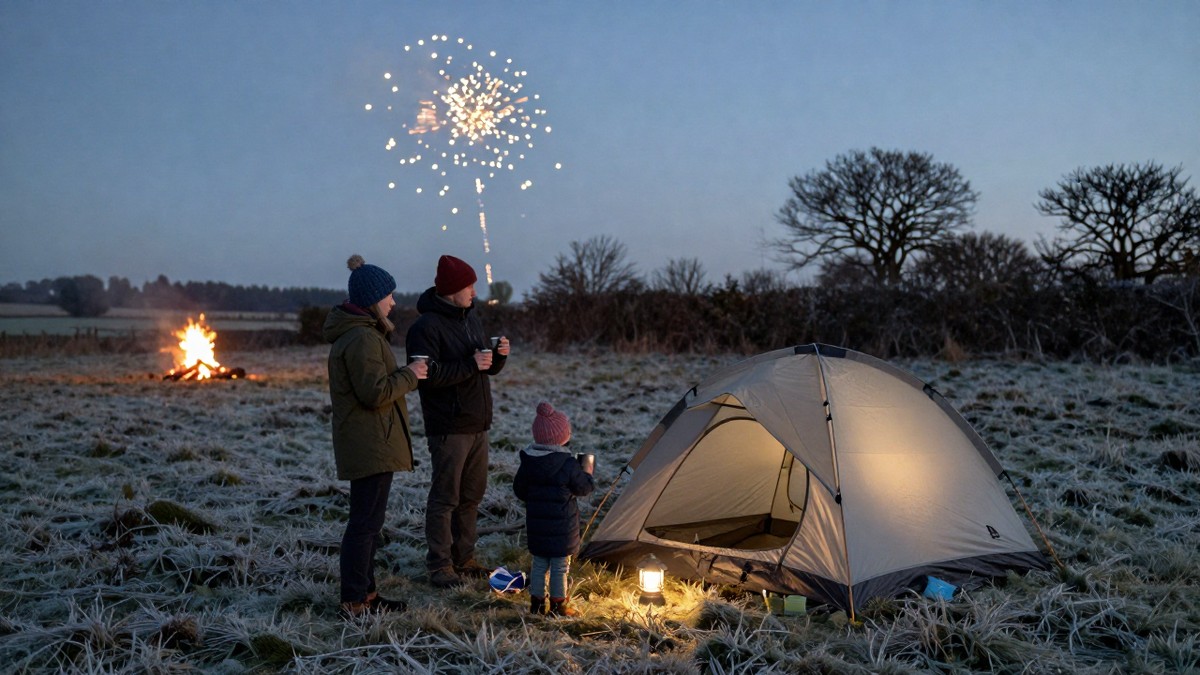
- Walk the pitch, then pitch high. Avoid dips and the field's lowest corner, point the door away from the wind and tension every guy line. Then cook while there is still light, fill the hot water bottle and set the lantern up inside before you leave for the display.
- Walk to the display, don't drive. Car parks near a display empty slowly. At a site event, stand upwind of the bonfire, keep children behind the barrier, and never bring your own fireworks or sparklers onto the field.
- Ventilate before you sleep. Open the top vents a finger's width even though it feels wrong. Trapped breath becomes condensation, and condensation dripping on a sleeping bag at three in the morning is the most common reason people write off November camping.
What goes wrong and how to recover
The stove sputters and dies
Almost always a chilled butane cartridge, which stops vaporising properly near freezing and cools itself further as it runs. Warm it in an inside pocket for ten minutes, or stand it in lukewarm water, never hot and never on the stove. Next time, pack a propane-butane mix.
Everything is wet inside by morning
Condensation, not a leak. Two people breathing in a closed tent on a cold night put a surprising amount of water into the air, and it settles on the flysheet. Open the vents tonight, keep wet clothes in the porch, and wipe the fly with a cloth before it drips.
The sleeping bag turns out to be a summer bag
The label said three or four seasons and the night said otherwise. Put on every dry layer, a hat and dry socks, refill the hot water bottle, and pull a spare coat over the top. Eat something; a cold body burns food to make heat. Still shivering? Sleep in the car with the seats down. That is the fallback, not a failure.
The dog will not settle
A dog that panics at fireworks has nowhere to go in a tent, and one that slips its collar in a dark field is a real emergency. Keep it on a lead throughout the display, sit with it in the car if it is frightened, and never leave it alone at the pitch. If you know your dog reacts badly, leave it at home that weekend.
The campsite has closed
It happens every year: a site listed as open on a directory shut on 1 November. Save a second site's number before you leave. If nothing is open within an hour's drive, a night at home and a day trip to the display beats a lay-by.
Frequently asked questions
Is Bonfire Night 2026 on a weekend?
No. 5 November 2026 is a Thursday. Most organised displays run on Friday 6 or Saturday 7 November, and a few towns hold theirs on Saturday 31 October alongside Halloween. Check the display date first and book the campsite around it, not around the 5th.
Can I have my own bonfire or fireworks on a campsite?
Almost never. The law lets you set off fireworks until midnight on 5 November rather than the usual 11pm cut-off, but campsite rules override that and nearly every site bans personal fireworks outright. Open fires on the ground are banned on most sites too; a raised fire pit is allowed on some, so ask before you pack one.
How cold does a tent get in November in the UK?
Close to the outside temperature. A tent stops wind and holds a degree or two of body heat, no more. Typical early November overnight lows in England and Wales sit between about 2 and 7 degrees, and a clear, still night inland can drop below freezing, so plan for frost and treat anything milder as a bonus.
Is a three-season sleeping bag enough for Bonfire Night?
Only if its comfort rating is below the forecast overnight low. Season labels mean little; the comfort figure under the EN or ISO rating is the one to trust. A bag with a comfort rating of 5 degrees is fine on a mild, cloudy night and miserable on a clear, frosty one.
Can I take my dog camping on Bonfire Night?
You can, but near a display it is a poor idea. A tent gives an anxious dog nowhere to retreat from bangs, and a dog that bolts from a pitch at night is hard to find in a dark field. If the dog is unbothered by fireworks and the site sits well away from any display, it can work; otherwise leave the dog with someone at home that weekend.